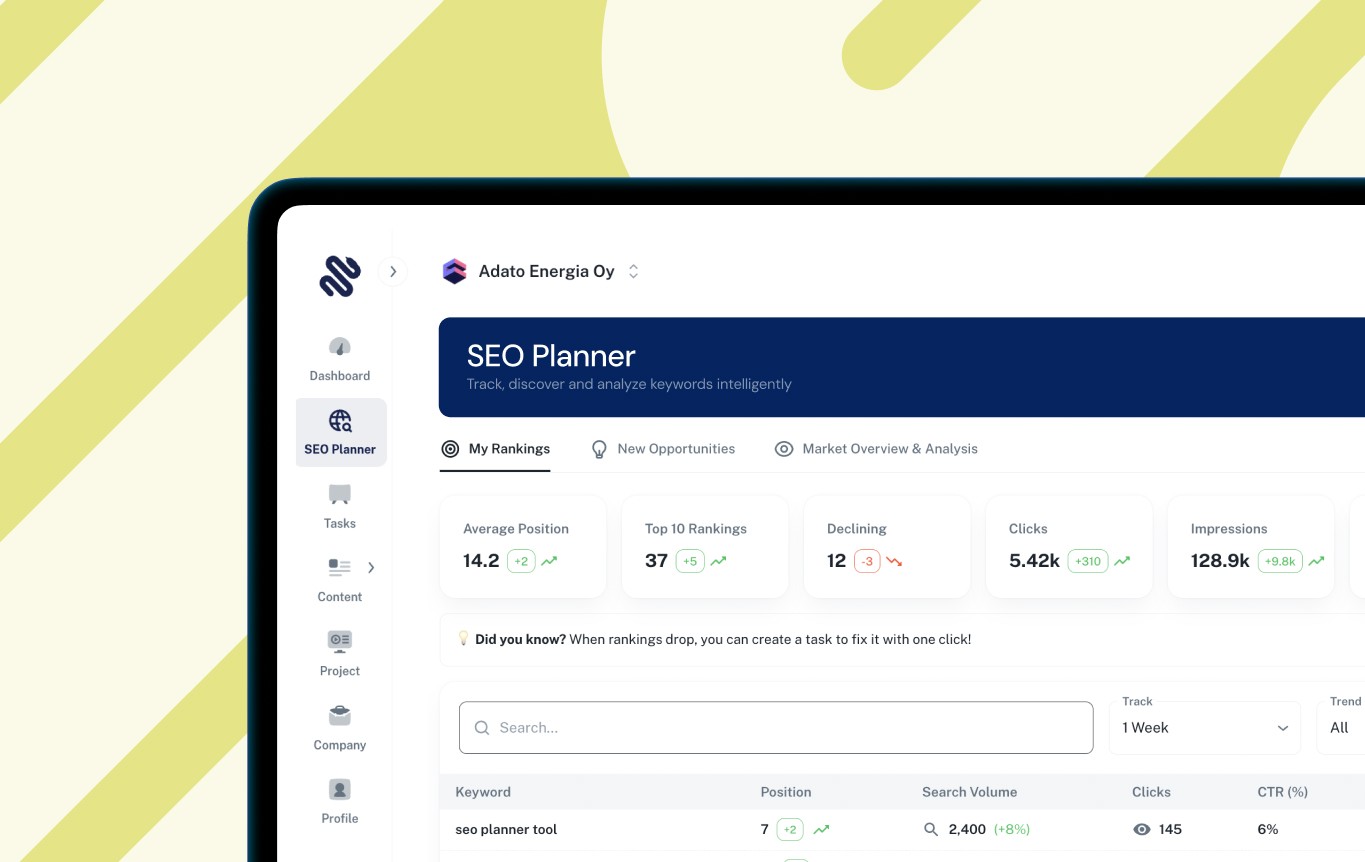
Choosing an AI SEO platform is hard when every tool promises the same results. You have limited time, and most tools still expect you to do the work yourself.
We explain how these platforms work, what separates a strong one from a weak one, and how to pick the right fit for your business. The aim is to help you decide without wading through numerous trials.
In shortThe best AI SEO platform depends on how much work you want to do yourself. Self-serve tools suit teams with time and SEO skill. Done-for-you platforms suit small businesses that want results without running the software. Dashboa combines proprietary AI with a team that manages everything for you.
What an AI SEO platform actually does
An AI SEO platform uses artificial intelligence to find keywords, plan content, fix technical issues and track how you appear in both Google and AI search. It brings the whole workflow under one roof, so you are not stitching together a keyword tool, an audit tool and a tracker. One system handles research, optimisation and monitoring together.

The stronger platforms read search intent, not just the words people type. We use Natural Language Processing and real-time data to understand what a searcher actually wants, so your content matches the question behind the query. A page about "fix a leaking tap" then answers the job the reader needs doing, rather than just repeating the phrase.
Search itself has split in two. People now get answers inside AI engines as well as on Google's results pages, so a platform worth its name tracks your visibility in both. If a buyer asks an AI assistant for a recommendation, you want to know whether your business shows up in that answer.
There is a big difference between a one-off audit and continuous monitoring. We continuously crawl the site and adapt the strategy as the market changes, rather than running a single audit and handing you a report. A one-off audit shows a snapshot, but a competitor can overtake you the following month, and a static report will not warn you.
To understand the detail behind each function, you can see how our AI-powered SEO solution works. For the groundwork, it also helps to learn the basics of AI optimisation before you compare platforms.
What are the best AI SEO tools for small businesses?
The best AI SEO tools for small businesses are the ones that need little setup, little SEO knowledge and little ongoing time from you. A small team rarely has an SEO specialist on staff, so a tool that assumes you can read a technical audit will sit unused. What matters is whether the tool turns into results without turning into a second job.
A cheap subscription can look like a bargain until you count the hours behind it. You still have to run the keyword research, write and optimise the pages, chase the technical fixes and read the reports. For a business owner who already covers sales, admin and delivery, that effort is the real cost, not the monthly fee.
- Little setup required to get started
- No in-house SEO specialist needed
- Covers both Google and AI search
- Clear, readable reporting
- Someone who runs it for you
- A predictable monthly cost
This is where a done-for-you model fits teams without a specialist. We pair AI models with a dedicated team of SEO and GEO strategists who manage the software for you, so the work happens whether or not you log in. You get the output of a platform without learning to drive it.
It also pays to understand how AI picks the companies it names. When someone asks an assistant to recommend a supplier, the model weighs what it can read about you across the web. That decides whether you appear at all, so it helps to know how AI chooses which companies to recommend.
Trust also comes from who else relies on a platform. Dashboa is trusted by 200 small and medium-sized businesses, which tells you the model is built for teams of that size rather than large in-house marketing departments. A platform tuned for small businesses asks less of your time and still reports in plain terms you can act on.
What is the difference between an AI writing tool and an AI SEO platform?
An AI writing tool produces text, while an AI SEO platform plans the strategy, optimises the content, fixes technical issues and tracks results. A writing tool drafts a blog post or rewrites a paragraph on request. A platform decides what to write in the first place, then checks whether it works once it is live.
A writing tool answers one question: what words go on the page. It drafts, rewrites and shortens, which saves you the blank-page problem. But it has no idea whether the topic has any search demand, or whether your site can even be found.
| Capability | AI writing tool | AI SEO platform |
|---|---|---|
| Produces content | Yes | Yes |
| Keyword and intent research | No | Yes |
| Technical audits | No | Yes |
| Tracks Google and AI search | No | Yes |
| Adapts strategy over time | No | Yes |
Writing alone does not improve rankings, which is where most buyers get caught out. You can publish a polished article and still rank nowhere if nobody searches that topic, or if a broken page structure hides it from Google. Good writing is necessary, but it is one step in a longer chain.
The two work together inside a full workflow. The platform finds the topic and the intent, briefs the content, and a writing step produces the draft. After publishing, the page is adjusted when results shift rather than left as it was.
A small business usually needs more than a writing tool once it wants steady traffic, not just published articles. If you have pages but no visitors, the gap is almost never the prose. To see how drafting fits into the wider job, you can read more about content production automation.
Want results, not just more tools? See how our AI and SEO team can run your search growth from research to tracking.
Get startedKey features that separate strong platforms from weak ones
A strong AI SEO platform covers the whole workflow: intent-based keyword research, content optimisation, technical health and tracking in both Google and AI search. A weak one gives you one clever feature and leaves the rest to you. The test is whether the platform carries a task from start to finish, or just hands you a list to act on.
Intent-based keyword research
Keyword research is only useful when it reads the intent behind a search. We use Natural Language Processing and real-time data to understand what a person actually wants, so you target the question rather than a bare phrase. A list of high-volume keywords means little if half of them attract readers who never buy.
Content optimisation has to go beyond dropping keywords into a page. A strong platform checks whether the page answers the full question, covers related points a reader expects, and reads clearly. Stuffing the target phrase in more often does not help, and can make the page worse for the person reading it.
Technical health checks matter most when they catch issues as they happen. A broken link, a slow page or a blocked crawler can quietly cost you traffic for weeks before you notice. A platform that watches for these in the background warns you early, rather than surfacing the problem in a quarterly report when the damage is done.
Tracking has to cover AI search engines, not only Google. Buyers now ask assistants for recommendations, and those answers draw on sources a standard rank tracker never looks at. If a platform only reports your Google position, you are blind to half of where your customers now look.
The deciding feature is a strategy that adapts as the market shifts. Rankings move, competitors publish, and search behaviour changes month to month. A platform that continuously crawls the site and adjusts the plan keeps pace, while a tool that ran its checks once leaves you working from an old picture.
Watch for weak signals too: isolated features that each need manual work to connect. A keyword tool here, an audit there and a separate tracker may look capable, but you become the glue that holds them together. A clear guide to AI search and SEO terms helps you judge what each feature really does before you commit.
Done-for-you AI versus self-serve SEO tools
A self-serve tool gives you the software and leaves the work to you, while a done-for-you platform runs the software and the strategy on your behalf. With a self-serve tool, you log in, pull the data and decide what to act on. With a done-for-you platform, a team makes those calls and carries them out for you.

From joining to results
The workflow runs from onboarding through automation to execution and measurable results. You join, the AI sets the strategy, the team deploys the changes, and the reporting shows what moved.
You see the output at each stage without having to run the steps between them yourself.
A self-serve tool expects a fair amount from you. You read the audits, write and publish the content, set up the tracking and interpret the reports. None of that is beyond a motivated owner, but it is time taken from running the business, and it assumes you know which signals to trust.
A done-for-you platform handles those jobs instead. The research, the optimisation, the technical fixes and the monitoring sit with the people managing the account. Your input drops to approving direction and reading plain updates, rather than operating the software week to week.
The hidden effort behind a cheap subscription is the catch. A low monthly fee buys access, but the work still has to happen somewhere, and with self-serve that somewhere is you. If you value your hours honestly, a tool that needs regular time is rarely the cheaper option it first appears.
Each model suits a different buyer. Self-serve fits a team with an SEO specialist and time to spend. Done-for-you fits a small business that wants the outcome without learning the craft or carving out the hours.
We combine both sides in one place. Our own proprietary AI technology runs the search strategy, and a dedicated team of SEO and GEO strategists manages that software for you. You get the speed of automation with people who deploy updates and adjust course, so nothing waits for you to click a button. To see where a managed model differs from one you run alone, you can compare automated SEO tools.
How to choose the right AI SEO platform for your business
Choose an AI SEO platform by matching it to your time, your SEO skill and whether you want to run it yourself or have it run for you. These factors decide more than any feature list. A capable tool is still the wrong choice if it needs hours and knowledge you do not have.
Start by being honest about your weekly capacity. SEO needs regular attention, not a single burst, so a tool that assumes a few hours a week only works if those hours genuinely exist. If they do not, a done-for-you platform saves the plan from stalling after the first month.
- Gauge your weekly timeDecide how many hours you can give SEO each week, honestly. This sets whether a self-serve tool is realistic at all.
- Assess your skillCheck whether anyone in-house can read an audit and act on it. If not, a tool that assumes that knowledge will sit idle.
- Choose the modelPick self-serve if you have time and skill, or done-for-you if you want results without running the software.
- Check search coverageConfirm the platform tracks both Google and AI search. Customers now look in both places for recommendations.
- Confirm reporting and costMake sure the reports are readable and the monthly cost is predictable, so you can plan around it.
Your in-house skill matters just as much. If no one can tell a useful audit finding from noise, the fanciest dashboard will not help, because the value lives in the decisions, not the data. A managed model removes that need, since the people reading the data already know what to do with it.
Coverage of both Google and AI search deserves a direct check too. A plan that wins Google rankings but ignores AI answers leaves you missing wherever buyers now ask for suggestions. Clear reporting and a predictable cost let you judge progress and budget without surprises.
For a sense of how a managed model is priced for a small team, you can see the SEO pricing options. Being used by 200 small and medium-sized businesses tells you the fit is built for teams of that size, not just large marketing departments with staff to spare.
Can ChatGPT do SEO?
ChatGPT helps with ideas, outlines and basic keyword suggestions. It lacks real-time data, technical audits and tracking, so it cannot replace a full SEO platform. Think of it as an assistant for drafting, not a system that plans strategy or measures results.
Is SEO replaced by AI?
No, AI changes how SEO is done but does not replace it. Search has moved into AI engines as well as Google, so the work now covers both. The job is still to be found when people look for what you offer, just across more places than before.
What are the best free SEO tools?
Free tools cover basic keyword research, rank checks and simple audits. They stop short of strategy, execution and AI search tracking, so you still do the thinking and the work yourself. They suit early experiments, not steady growth that needs ongoing attention.
Is SEO still worth it in 2026?
SEO remains worth the investment because search now spans both Google and AI engines, making visibility in both matter more. As buyers increasingly ask AI assistants for recommendations, being found across those answers becomes part of the same job.
Do I need technical skills to use an AI SEO platform?
It depends on the model. Self-serve tools need SEO knowledge to get value, because you read the audits and decide what to act on. A done-for-you platform removes that need, since a team runs it for you and reports in plain terms.
See how an AI SEO platform works for you
Find out how our proprietary AI and SEO team can run your search growth. Get started and see where you stand.
Get started